
Instead of relying on multiple tools, AiPrise uses AI agents to automate decision-making, reduce manual effort, and improve accuracy across the entire onboarding journey. This allows businesses to scale faster while maintaining strong compliance and a smooth user experience. While digital tools make the process more efficient, businesses must still balance ease of use with the necessity of complying with regulations.
Documentation and Audit Readiness
Liveness detection can ensure that a person is present during the process, and the AML ongoing monitoring minimizes any future risk. As technology continues to advance, the landscape of KYC compliance is likely to evolve further. The use of artificial intelligence, blockchain technology, and biometric authentication will become more prevalent in KYC processes. These advancements will enhance security, efficiency, and the customer experience. Internally, turning KYC into a trust engine requires closing the loop between compliance, product, and customer-facing teams. Front-line staff should be able to explain KYC requirements in plain language, empathize with customers who are frustrated by paperwork, and escalate edge cases quickly instead of leaving applications to languish.
Many organizations use AI-powered verification tools to speed up the process and improve accuracy. In particular, KYC guidelines in financial services mandate that individuals make a cohesive effort to verify the identity, suitability, and risks involved with maintaining a business relationship. That’s because even on an e-commerce marketplace, which is also subject to KYC, users need to create an account and start purchasing/selling items.
- This structured process helps businesses prevent financial crimes, such as money laundering and fraud, while building trust with their customers.
- A provider may ask a customer to verify details again if an ID expires, account activity changes, or regulation requires a refresh.
- Through this structured KYC process, organisations can ensure regulatory compliance, minimise exposure to financial crime, and establish secure and trustworthy customer relationships.
- As technology continues to advance, the landscape of KYC compliance is likely to evolve further.
- To prevent this, KYC requirements mandate that businesses verify the identity of their clients, assess risks, and report suspicious activities through SARs (Suspicious Activity Reports).
- In 2022, for example, an expected 65.3 percent of Americans will use digital banking.
Ensure all Documents and Processes Follow the Same Format for Global Compliance
Additionally, by enabling constant monitoring of your clients, you’ll know exactly which of them needs to be remediated. Ondato offers all the necessary KYC and data monitoring tools in one comprehensive suite. Stay compliant with current regulations and mitigate the risk of fraud with our customer data platform.
Identity layer
Together, KYC and AML protect financial institutions from being used for illegal activities while ensuring they comply with legal requirements. Accurate documentation is essential for a smooth KYC verification process and compliance with regulatory requirements. The three core components of KYC are the Customer Identification Program (CIP), Customer Due Diligence (CDD), and ongoing monitoring.
Commonly Required Documents for KYC Verification
Product and UX teams need direct feedback from compliance on where customers drop off, which document types generate the most back-and-forth, and which questions create confusion. That insight can drive targeted improvements, such as offering alternative verification options, adding tooltips and examples, or using prefilled data from existing relationships. These technology solutions not only improve the efficiency and accuracy of KYC processes but also help businesses stay ahead of evolving regulatory requirements. The rise of digital transformation has redefined how organizations approach KYC (Know Your Customer) compliance. Traditional, manual verification processes are being replaced by smart, automated solutions powered by AI, biometrics, and blockchain.
Proof of identity
This list https://ibushio.net/FxVerge-User-Reviews-Reliability-Transparency-and-the-Real-Trading-Experience/ comprises banks, major financial institutions, payment service providers, credit card companies, fintech companies, insurance companies, real estate firms, among others. The Know Your Customer Rule 2090 and FINRA Rule 2111 are both regulations put in place by the Financial Industry Regulatory Authority (FINRA). The Know Your Customer Rule 2090 requires firms to take reasonable steps to gather information about their customers’ investment profile, including their risk tolerance and investment objectives. FINRA Rule 2111, on the other hand, deals with the suitability of investments for customers and requires firms to have a reasonable basis for recommending any securities products. Together, these rules help to protect investors by ensuring that they are only being recommended products that are suitable for their individual needs.
Frequently Asked Questions About the KYC Process
Digital KYC is an automated, technology-driven approach to the kyc process that uses online tools to verify customer identities quickly and securely. It replaces manual verification with AI, making the kyc verification process faster, more accurate, and scalable. This method improves efficiency in the kyc onboarding process, reduces unnecessary friction in the customer onboarding process kyc, and ensures better regulatory alignment.

It’s a detailed process that protects financial institutions and other regulated sectors from fraud and unwanted business relationships that can lead to major non-compliance fines. Organizations that deal with financial transactions are required to have an AML (anti-money laundering) policy, and KYC falls within this scope. As a set of guidelines, the main elements of KYC include a customer acceptance policy (CAP), a customer identification policy (CIP), transaction monitoring and reporting, and risk management. Fintech companies must implement robust KYC measures to ensure the integrity of their services, such as verifying customer identities through biometric data and monitoring transactions for suspicious activity. It’s a way to ensure that customers are who they say they are and that their finances are legitimate.
Our Services
KYC verification matches the names of people trying to open accounts against a watchlist and can therefore block suspected terrorists from using these financial services. With KYC, government agencies are able to track money that is being generated and transferred and can potentially be funding terrorist operations in order to stop the money from changing hands. The aim is to keep customer records accurate and identify risk changes over time rather than relying only on the original onboarding file.
Ensure regulatory compliance across jurisdictions
It is especially true for companies that offer age-restricted services and want to deter minors from using their platform. However, KYC regulations require financial institutions to combine these two types. In-Person-Verification, also known as Manual Verification, refers to a physical KYC process. A customer must physically deliver relevant KYC documents, such as their ID, proof of address, etc. The KYC specialist will then run the data against various registries to confirm authenticity. This method allows compatible devices to extract and wirelessly transfer data from microchips.
Her expertise lies in breaking down complex topics into engaging, easy-to-understand content. With a keen eye for detail, Teresa has successfully covered a range of article categories, including currency exchange rates and foreign exchange rates. You may need to file a Suspicious Activity Report (SAR) if the account activity is deemed unusual. Some factors to monitor may include spikes in activities, out of area or unusual cross-border activities, inclusion of people on sanction lists, and adverse media mentions.
While some manual investigations will always be needed, automation streamlines the process and escalates only certain issues that require further investigation, reducing demand on employees. While KYC starts with identifying the customer before doing business with them, it doesn’t end there. Compliance is a crucial part of client lifecycle management (CLM), which tracks the customer throughout their association with the financial institution. Screen against sanctions lists (OFAC, EU, UN, HMT), watchlists, adverse media, and PEP databases — at onboarding and continuously.
Selfie or liveness check
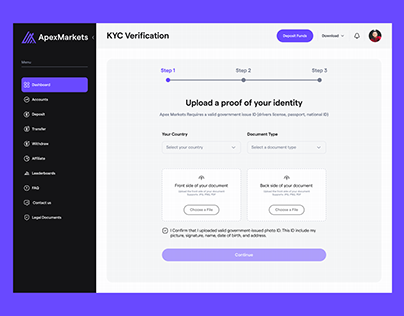
The first is identity proof, typically a government-issued photo ID such as a passport, national ID card, or driver’s license. The second is proof of address, which is a utility bill, bank statement, or tax document dated within the past 90 days. CIP might sound simple, but it is where many businesses first encounter friction. Manual verification of these documents can cost financial institutions up to $500 per customer, and delays can stretch onboarding timelines from minutes to weeks. This cost-friction tension is one reason the industry has moved aggressively toward electronic verification, or eKYC, which uses automated document scanning and database cross-referencing to compress the process.